
Chesterfield Previous Residents Across Record Eras
Previous residents leave different kinds of traces in different eras. Begin with the current parcel and its recorded transfer, then move to the source nearest the date you need. A deed identifies parties to a transaction, but not a move-in day. A directory is an annual publisher's snapshot, while the census records a household on its census date. The Chesterfield Record Room, Central Library, the Library of Virginia, and the Historical Society form the practical fallback chain when an online result stops.
| Trail source | Verified span | Where to use it | What it can add |
|---|---|---|---|
| Permanent land and court series | 1749 to present | Circuit Court Clerk Record Room | Full county record series, with different online subsets |
| Online deed index | 1967 to current | Chesterfield Land Records | Name-indexed deeds and land instruments |
| Historic deed books and indexes | Deeds 1749 to 1866; general indexes 1749 to 1913 | Clerk originals, LVA microfilm, FamilySearch catalog | Earlier owners, legal descriptions, conveyances |
| Local city and county directories | LVA selection 1873 to 1960; local run not posted | Central Library, LVA, Ancestry | Annual address, occupant, and occupation clues |
| Federal census | 1790 to 1950 released | NARA, library databases, genealogy collections | Household relationships, ages, birthplace, and residence |
| Marriage and vital indexes | Marriage 1936 to present; birth and death index 1912 to present | VDH, LVA, Clerk, library resources | Family and event clues, subject to access limits |
| Manchester Sanborn maps | 1895, 10 sheets | Library of Congress digital collection | Building footprint, material, use, and street context |
| ELM permits | Current online period not stated | ELM and Building Inspection | Construction, review, inspection, plan, or occupancy evidence where public |
| CHSV research files | No single date run | Historic Trinity Church research library | Manuscripts, maps, photographs, clippings, and family files |
For a recent transfer, start with READ and the online deed index. For an older address, begin with the legal description and move through the Record Room, Library of Virginia reels, or FamilySearch catalog. Use printed directories and census schedules to test who lived at the property between recorded ownership changes.
Start a Chesterfield Address Trail in READ
Chesterfield Real Estate Assessment Data, known as READ, is the current-address bridge for previous residents research. Search broadly by address or owner, then record the parcel or tax ID, current owner, situs address, tax mailing address, legal description, subdivision or lot context, assessments, improvements, and any ownership-history clue. The tax mailing address may be somewhere else and is not a statement that the owner lives at the property. The legal description and parcel ID are more dependable links to an older deed.
The READ public search is the official starting screen for a Chesterfield address trail.
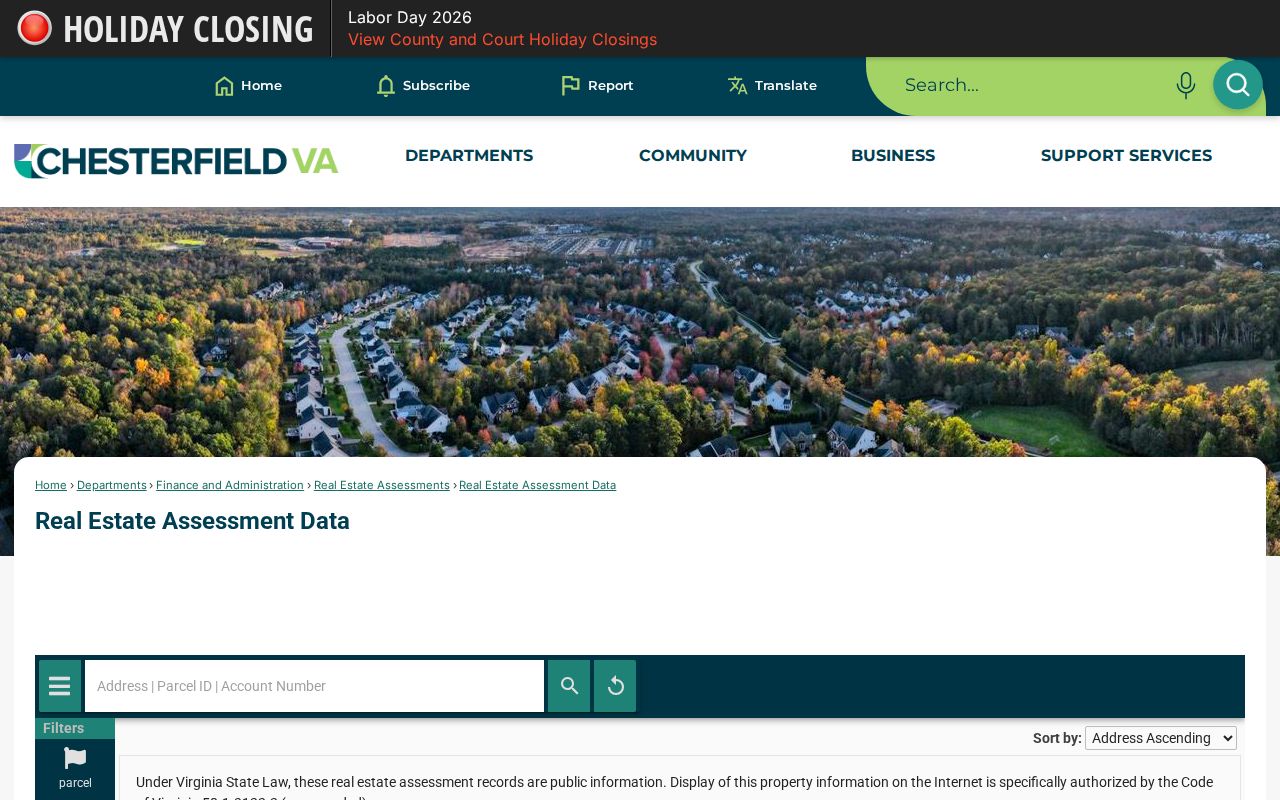
The search controls make it possible to begin with an address or owner and narrow with property characteristics before preserving the parcel details for the deed chain.
READ is assessment administration, not recorded title. The county notes that assessment data can lag a recorded deed, so compare a parcel result with the Clerk's document before treating a transfer as current.
Chesterfield Previous Residents Need Name Searches
The key Chesterfield research quirk is that the Clerk's land index is organized by party name, not by street address or legal description. The address is a bridge, not a deed-index search key. After READ gives the current owner and parcel details, search that owner as the grantee in Chesterfield Land Records. Narrow by the likely period and open the candidate purchase deed. Match the parcel's legal description, subdivision, lot, acreage, and tax ID rather than relying only on a matching surname.
The document can show the grantor and grantee, document type, recording date, book and page or document number, consideration, and legal description. If the image is not available through the public view, use the Clerk's subscriber-image route, inspect the record at the Record Room, or request a copy. Copies cost $0.50 per page; certification adds $2 per document.
Note: Search individual names, married or maiden variants, initials, estate names, trustee names, and entity names because an occupant may not be the party indexed on a deed.
Chesterfield Deed Chains Run Backward
A chain of title is the sequence of recorded transfers for a particular tract. It is the core process for finding past owners, and it has to be built from the document parties and legal description. Each step should be logged with the recording date, deed type, grantor, grantee, book or document number, consideration, parcel ID, legal description, image or copy status, and a confidence note. A recorded transfer may explain ownership without establishing the day a household arrived.
- Open the READ parcel and record the current owner, 15-digit tax ID, legal description, subdivision, and situs address.
- Search the current owner as grantee in the land index and locate the likely purchase deed.
- Verify that deed against the legal description, tax ID, lot or acreage, and recording date, then identify the seller or grantor.
- Search that grantor as grantee in earlier dates to find the prior acquisition, repeating the same legal-description check.
- At the online cutoff, continue with the Record Room's grantor and grantee indexes, LVA microfilm, and FamilySearch catalog volumes.
- Grantor and grantee
- The grantor transfers an interest in the document. The grantee receives that interest.
- Chain of title
- The linked sequence of recorded ownership transfers for one parcel or tract.
- Legal description
- The lot, block, subdivision, metes-and-bounds, or other land description used to distinguish the tract from a street label.
Chesterfield Deed Records Before 1967
The 1967 online deed cutoff is an online-access boundary, not a loss of the Chesterfield record. The Circuit Clerk says permanent land and court material begins in 1749. When a prior owner falls before the public online index, take the names and legal description to the Record Room. Staff can help navigate the books and indexes, but cannot perform a title search or interpret title.
The Library of Virginia's Chesterfield microfilm catalog identifies county series, and the FamilySearch catalog lists 25 reels of deed books from 1749 to 1866 plus general indexes through 1913. Some LVA reels are unavailable through interlibrary loan, so consult the catalog or an archivist before planning a remote request. The same party, date, and legal-description method still applies.
Chesterfield Directories Between Census Years
Deeds track recorded ownership. Previous residents often need the household layer between those transfers. Central Library's Local History Collection includes city and county directories, yearbooks, vital records, family genealogies, military material, microfilm, and a reader. The Library of Virginia and Ancestry provide a verified statewide Virginia city-directory selection from 1873 to 1960. Exact Chesterfield shelf and reverse-directory runs are not posted online, so ask the local-history desk before assuming a year is available.
- Search the surname, initials, occupation, and street in the directory's name section, then check the street or reverse section if the volume has one.
- Write down street spelling, number, apartment or room notation, neighboring names, and any widow, boarder, or business notation.
- Check a directory one year before and after the target date because publication and canvass dates can differ from the year printed on the cover.
- Pair the closest result with the 1900, 1910, 1920, 1930, 1940, or 1950 census schedule to compare household relationship, age, birthplace, and occupation.
- Use the last confirmed listing as a lead for a deed party, obituary, probate file, church record, or next address.
A directory listing is not legal proof of residence. It may carry a business address, supplied information, or a stale entry. The collections themselves are described on the Chesterfield city directory page, while this address trail uses them to test a particular period.
Note: Individual census schedules through 1950 are public as of 2026; later federal census data is aggregate rather than a household source.
Chesterfield Previous Residents Near Manchester
Manchester is a local history issue, not just a spelling variation. It became an independent city in 1870 and later joined Richmond. Richmond's 1970 annexation brought 27 square miles and more than 47,000 former Chesterfield residents into Richmond's perimeter. A former Chesterfield address may therefore be filed in a Richmond or Manchester collection depending on the date.
Boyd's 1869 Richmond directory includes a Manchester listing, and the Library of Congress has a 10-sheet 1895 Manchester Sanborn map set. Compare the date, street grid, map, and legal description before choosing the next custodian. Chesterfield also lost one marriage register and loose court papers during the Civil War, so an absent record should lead to substitute church, newspaper, probate, tax, deed, or surviving microfilm evidence rather than a final conclusion.
Chesterfield Maps and Permit Dates
The 1895 Manchester Sanborn sheets can show a building footprint, material, use, nearby lots, and street layout, but they do not cover every present-day Chesterfield community. They are a building-context tool, not a list of former residents. Use the historic map alongside a parcel's legal description and historic jurisdiction label.
For later changes, the ELM Citizen Access Portal can expose address or parcel-linked permit data, including record number, permit class, project status, review or inspection status, comments, approved documents, and certificates of occupancy where public. A permit can date construction, demolition, or renovation. It cannot name all people who lived at the property.
Chesterfield Previous Residents at Trail Endpoints
An obituary, probate record, and death index can explain why a name leaves an address chain. A death notice may name a spouse, children, church, funeral home, or last residence. A will or probate file may identify an executor, heirs, and parcel disposition. Use the Virginia Department of Health index for an event clue and the Circuit Clerk for estate or court records; newspapers and funeral-home notices are corroboration, not a substitute for the custodian's record.
Virginia limits certificates and recent vital records. Birth records become public 100 years after the event, while death, marriage, and divorce records become public after 25 years under Va. Code § 32.1-271. Central Library, the Library of Virginia, and the Chesterfield Historical Society's manuscript, vertical-file, map, photo, and family-history collections may provide supporting local context when the record trail ends.
Limits on Chesterfield Previous Residents
Property ownership and an old directory listing cannot identify every person who stayed at an address. Mailing addresses can differ from situs addresses. A deed date is not necessarily a move-in date. Private membership, utility, school, driver, and protected-address information is not a public household roll. The Virginia Address Confidentiality Program and protected-voter status can lawfully substitute or suppress an address.
Use the backward trail for family history, house history, estate questions, and personal curiosity. Respect record dates, access rules, and the difference between a document party and a person living at a property.
Lawful use. Chesterfield previous-resident research supports house history and personal, lawful research. Do not use address or family-history records to stalk, harass, intimidate, or harm any living person.